Hamburg, 09 July 2026 – It sent a strong signal to the industry when the British government awarded leases to twelve offshore projects rated for a total wind power output of nearly 8.5 gigawatts – the largest single tender for wind energy in the history of Europe. “With these results, Britain is taking back control of our energy sovereignty,” said Ed Miliband, the UK’s Secretary of State for Energy Security and Net Zero. “This is a historic win for those who want Britain to stand on our own two feet, controlling our own energy rather than depending on markets controlled by petrostates and dictators.” The recently-awarded projects will supply enough energy for twelve million households and represent a total investment of over 22 billion pounds. “Offshore wind is back. The oil price shock has given another major boost to renewable energy,” says Claus Ulrich Selbach, Vice President Exhibitions at Hamburg Messe und Congress. At the world’s leading wind industry fair, more than 1,600 market players will highlight their innovations – and the offshore segment will be aptly represented by leading companies from around the world.
Complex requirements, holistic perspective
The industry has been faced with numerous challenges recently: In the USA, the Trump administration tried to shelve offshore wind farm projects, some of them near the point of completion; in Germany, the French Total Energy corporation is said to be contemplating returning a concession for a project in the North Sea citing grid integration issues. Many other players are dealing with a similar situation, not to mention rapidly rising costs and unclear legal and political frameworks. Not surprisingly, the general mood is muted, according to the 17th WindEnergy trend:index, a recent industry survey. Nevertheless Peter Constantin Brun, Global Segment Leader Offshore Wind at DNV, remains optimistic. “As a power generator technology, offshore wind has a lot to offer to help deliver on increased power demand from electrification and establish independent security of energy supply,” says Brun. “Government and regulators will however need to establish the needed policy frameworks to stimulate and enable this, such as a stable auction design, faster permitting and grid approval processes and stronger cross-border cooperation. At project level, the success depends on understanding the interrelationships between different parts of the offshore wind energy value chain. It is essential to adopt a holistic life-cycle approach in order to manage risks and reduce costs,” the DNV segment leader adds. The independent engineering consultancy and certification agency will present its portfolio of services at WindEnergy Hamburg.
Close collaboration, joint success
Expanding offshore wind energy is technically complex, requiring perfect coordination between many different parties. “Close cooperation is the key to the industry’s future development, and our flagship fair is the perfect platform to promote this,” says Andreas Arnheim, Director WindEnergy Hamburg. Europe’s ambitious development plans for wind motivate Agustin Delgado Martin, CTO of the leading Spanish energy corporation Iberdrola Group. “Shared ambition becomes collaborative action when Europe adopts a holistic approach and ensures alignment across all strategies, not only energy, but also digitalisation, innovation, and industry. Europe’s energy transition will only succeed if ambition is matched by concrete steps. To make this happen, we need vertical and horizontal collaboration among key actors across the entire energy value chain, including the public sector, technology providers, and industry.” Iberdrola aims to boost its global installed offshore wind capacity by 3.5 gigawatts by the year 2028 and invest around eight billion euros.
Broad variety, specific expertise
The entire value chain of the wind industry will be represented at WindEnergy Hamburg, from project developers and financiers to equipment manufacturers and installers, and through to grid integration specialists and operators. Transport, installation and maintenance of offshore units require highly specialised expertise. Shipowning companies provide purpose-built ships for these activities. Examples include the Belgian company Jan de Nul whose offshore installation vessels are deployed around the world. The Norwegian company Fred. Olsen Windcarrier has successfully installed more than 1,100 offshore wind turbines to date. The Dutch firm Van Oord owns the world’s largest floating crane, among other specialised ships, such as large cable layers. And WINDEA Offshore’s fleet of commissioning service operation vessels (CSOV) and crew transfer vessels makes sure installation and maintenance teams are well accommodated, and safely transported to and from offshore wind turbines.
International scope, regional integration
In the offshore segment, collaboration happens on a global scale: For example, a consortium including Seatrium and GE Vernova was awarded the grid intertie project BalWin 5 in late 2025. Its purpose is to feed the power generated by wind farms in the North Sea into the German power grid. The Singapore-based company Seatrium has evolved from a shipyard to a leading supplier of offshore wind infrastructure. “Seatrium has delivered or is in progress of delivering 16 GW of offshore wind products. This is more than the installed base of Singapore’s (power grid),” reports Chris Ong, CEO of Seatrium. The Gennaker project located offshore the German state of Mecklenburg-Western Pomerania exemplifies the importance of collaboration across the industry. Wind farm developer and operator Skyborn Renewables recently awarded a bundle of contracts for the project: the monopile foundations will be supplied by EEW Special Pipe Construction and the transition elements by DajinHeavy Industry. The foundations will be transported and installed by Seaway7 whereas a consortium comprising Boskalis and TKF will supply and lay the connecting cables between the turbines. “The agreements demonstrate our commitment to Gennaker being rooted in the local community, delivering long-lasting value and benefits for Mecklenburg-Wester Pomerania. Offshore wind delivers positive impact on the ground, be that via investments, jobs or decarbonisation,” says Patrick Lammers, CEO of Skyborn. With an output rating of 976.5 MW, Gennaker will be the largest wind farm in the German Baltic Sea. It is scheduled for completion by 2028.
Huge potential, positive outlook
Offshore wind is back: The current billion-euro contract for a power converter platform awarded by grid operator 50Hertz to a consortium consisting of Neptun Smulders Offshore Renewables and Siemens Energy is another proof. The contract demonstrates the potential of offshore wind development as a booster of industrial value chains, jobs and innovation in Germany, says Stefan Thimm, Managing Director of the Federal Association of Offshore Wind Energy (BWO). “Wind energy generated in the North and Baltic Seas not only delivers climate-friendly electricity but also provides concrete positive perspectives to shipyards, ports and suppliers along the entire value chain.”
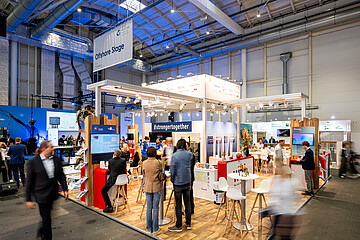
These and other topics will be on the agenda of the freely accessible conference programme at WindEnergy Hamburg. On six open stages, over 300 top-flight speakers will discuss the industry’s big issues such as so-called Contracts for Differences (CFD), which guarantee a minimum price for power to minimise the financial risk for wind farm operators. The Danish energy agency, for example, has switched to this more attractive system after a call for bids had failed spectacularly. Now a total of 7.4 billion euros are available for the twenty-year funding period for three planned wind farms with a total rated output of 2.8 gigawatts. Other featured conference topics will include new developments in floating wind turbine platforms, protection of critical infrastructure against hybrid attacks, as well as wake effects between individual turbines or entire wind farms which can compromise the economic viability of projects. The conference programme on the Offshore Stage in Hall B5 will be organised jointly by the WindEnergy Hamburg team and the World Forum Offshore Wind (WFO). “Whether grid connection challenges, integration of energy storage technologies, or AI-based maintenance tools: at WindEnergy Hamburg 2026, policymakers, administrators and scientists will meet the leading players of the wind energy industry to jointly shape the future of onshore and offshore wind energy,” says Claus Ulrich Selbach, Vice President Exhibitions Maritime & Energy at Hamburg Messe und Congress.