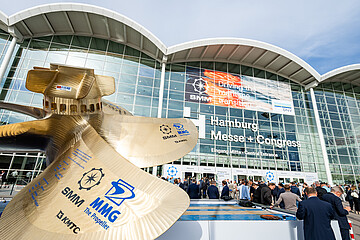
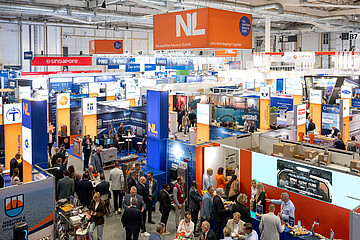
Hamburg, 4 September 2026 – For four days, SMM 2026 focused on the key challenges facing the maritime industry – from maritime security and resilient supply chains to energy efficiency and new propulsion technologies, artificial intelligence and autonomous systems. Shipping companies, shipyards, suppliers, technology companies, navies and international organisations used the event to discuss investment, new technologies and partnerships.
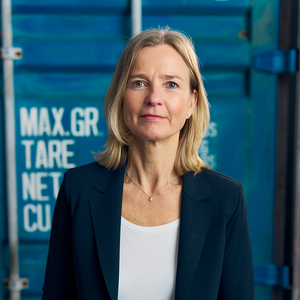
“What we have seen over these four days is an industry with a strong determination to shape its future. Despite geopolitical and regulatory uncertainty, companies are investing, seeking solutions and building new partnerships. Across all topics, there was a clear sense that available technologies need to be deployed more quickly,” says Claus Ulrich Selbach, Vice President Exhibitions Maritime & Energy at Hamburg Messe und Congress.
Security and resilience move centre stage
The growing importance of maritime security was particularly evident in the new NavalHall B8. The MS&D Conference & Expo and the Naval Stage brought together international navies, defence companies, maritime suppliers and providers of dual-use technologies. The focus was on unmanned systems, sensors, cybersecurity and the protection of critical maritime infrastructure.
“Decarbonisation remains important, but safety at sea and the protection of sea lanes are currently the number one priority. We need to get ships into the water quickly and significantly shorten procurement processes. Industry is ready: many of the products and technologies we need already exist and do not have to be developed from scratch,” says Klaus Deleroi, Managing Director of REINTJES.
The response to the new Naval Hall was correspondingly positive. “SMM is an important platform for us to engage personally with partners and suppliers. The new Naval Hall is an excellent addition and has been very well received by visitors,” says Oliver Grün, Spokesman Division Naval Systems of Rheinmetall AG.
At the MS&D Conference, a key question was how navies can acquire the capabilities they need in response to the changed security environment. Senior naval representatives from several countries discussed new technologies, procurement and closer cooperation with representatives from industry and research.
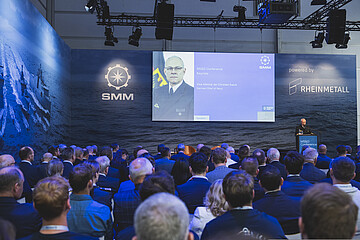
Vice Admiral Jan Christian Kaack made a particular impact during his final public appearance as Chief of the German Navy. The focus was on greater operational readiness, shorter procurement processes and the increased use of unmanned systems. Kaack stressed that, given the current security situation, available and proven solutions need to be procured more quickly. In the discussion that followed, he also advocated closer interaction between manned and unmanned systems. Rear Admiral Christian Bock, Head of the Bundeswehr Innovation Center, underlined the need for action: “SMM and MS&D are important platforms for identifying new technologies at an early stage and bringing innovations into operational use more quickly.”
The protection of critical maritime infrastructure was also a central topic at the Offshore Dialogue. Moderator Dr Walter L. Kuehnlein highlighted in particular the open and lively discussion with the audience about technological and operational solutions.
Efficiency becomes a business case
While security and resilience are playing a greater role on the agenda, decarbonisation and energy efficiency remain key challenges for the industry. Against a backdrop of uncertain regulatory conditions and continuing uncertainty over the fuels of the future, attention is increasingly turning to technologies that can be deployed today to reduce fuel consumption and emissions. At the new Energy Efficiency Hub, 24 companies presented solutions across 300 square metres, ranging from wind propulsion and alternative propulsion technologies to measures for optimising existing fleets.
“The Energy Efficiency Hub is a valuable addition to SMM. What stood out to us in particular was how specific the discussions have become: shipping companies are actively looking for solutions to improve fleet efficiency and are increasingly exploring technologies such as wind propulsion that can already be deployed today,” says Ada Ak, Sales Engineer at BAR Technologies.
The Global Maritime Environmental Congress (gmec) on the Energy Efficiency Stage demonstrated that decarbonisation continues to be a major concern for the industry. In front of a capacity audience, industry representatives discussed the path towards climate-neutral shipping. The focus was on collaboration across the maritime value chain and on Green Shipping Corridors as a potential model for advancing decarbonisation across the maritime sector.
AI moves into real-world application
In digitalisation and artificial intelligence, the focus shifted towards implementation. Rather than discussing theoretical potential, conversations at SMM increasingly centred on specific applications – from fleet optimisation and predictive maintenance to autonomous systems and AI-based situational awareness.
“At SMM 2026, we can clearly see that the conversations are becoming more specific: customers are asking less about the potential of AI and more about ready-to-use solutions for collision avoidance on board. The quality of the discussions was noticeably higher this year,” says Patrick Haebig, Senior Sales Manager EMEA North at SEA.AI. Anschütz reported growing demand for AI-supported applications. Discussions focused, among other things, on bringing together data from different sources to support navigation and decision-making on board.
The Maritime Future Summit picked up on this development. Discussions explored where AI can add value in operations and where its limitations lie – for example in safety-critical applications, certification, liability and the traceability of AI-based decisions. “The interaction between artificial intelligence and human intelligence is one of the key factors in advancing the industry. It is not about integrating AI everywhere on board or into every process, but about finding the ‘sweet spots’,” says Michael Meyer, moderator of the Maritime FutureSummit.
Alongside technological and security-related topics, attracting the next generation of maritime professionals remained an important focus. During the two-day Maritime Career Market, companies, universities and industry associations engaged with students, young professionals and maritime specialists.
International business is built face to face
SMM's international reach was once again evident in 2026: 26 national pavilions and delegations from around 30 countries underlined the event's global scope. For the first time, India, Cyprus and Brazil were among the countries represented with their own national pavilions. Exhibitors from many countries reported high-quality discussions, new contacts and business opportunities. India's strong presence was particularly visible this year. According to the Indian Ports Association, ports, shipyards and maritime companies used SMM to exchange ideas, establish new business contacts and build long-term partnerships.
Danish exhibitors also drew a positive conclusion: “SMM is a unique meeting place for the maritime industry. Our exhibitors held numerous discussions with international business partners that will lead to new collaborations. We will be back in 2028 with a strong Danish presence,” says Mie Jakobsen, Deputy CEO and Head of Marine at the Danish Export Association, which organises the Pavilion of Denmark.
Junichi Hirata, Managing Director at CAJS in Japan, summed it up succinctly: “SMM is the Maritime Olympics!”
The mood across the industry over the four days was exceptionally positive. Exhibitors reported high-quality discussions, a strong presence of decision-makers and continued willingness to invest despite ongoing uncertainty. “SMM 2026 has been an excellent week for Alfa Laval, with a high level of engagement and substantive conversations across the industry. What stood out was the strong focus on turning ambition into action; whether through energy efficiency, alternative fuels, digitalization or new innovative technologies. There is clearly still uncertainty in the market, but we also see a real willingness to invest where solutions can deliver tangible operational and environmental value. We leave Hamburg encouraged by the momentum towards accelerating ocean innovation together across the maritime value chain,” says Helena Sannicolò, Vice President, Marketing & Communications, Ocean Division at Alfa Laval.
Staying the course – and picking up the pace
“After four days of SMM, one thing is particularly clear to me: this industry is not standing still. Companies are investing, seeking partners and looking to deploy available technologies more quickly. Especially in the face of geopolitical and regulatory uncertainty, this determination to act is crucial. SMM brings together the players who can jointly move solutions forward,” concludes Selbach.
Maritime security and defence will remain firmly on the agenda in Hamburg in 2027: the next MS&D Conference & Expo will take place on 8 and 9 December 2027, alongside the Global Security and Defence Summit (GSIS) at the CCH – Congress Center Hamburg.
SMM 2026 in figures: More than 50,000 participants for the first time
With more than 50,000 participants, SMM 2026 achieved record attendance. People from 134 nations came to Hamburg over the four days of the event. Around 2,300 exhibiting companies from 66 countries presented their solutions across more than 90,000 square metres in twelve exhibition halls. More than 70 per cent of exhibitors came from outside Germany.
The figures communicated are based on an extrapolation from the final day of the event as of 12 noon and are preliminary. Due to a change in the methodology used for the qualified visitor survey, final figures on overall satisfaction are not yet available at the time of publication.
The next SMM will take place in Hamburg from 5 to 8 September 2028.