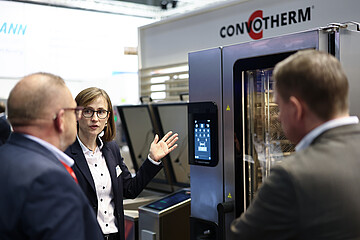
Hamburg, 12 November 2026. Many kitchens are short of skilled staff. At the same time, labour, energy and food costs are high. From 12 to 16 March 2027, INTERNORGA will demonstrate how modern technology can ease the workload for teams, save energy and reduce food costs in its Kitchen Technology & Equipment area. In Halls B6 and B7, around 200 exhibitors will present appliances and equipment for professional kitchens, ranging from connected combi steamers and refrigeration systems to food distribution solutions.
The scale of the cost pressure is illustrated by a DEHOGA member survey conducted at the beginning of 2026. In the survey, 75.2 per cent of businesses named labour costs as their greatest burden. Energy costs were identified as an urgent problem by 65.7 per cent, while 64.6 per cent considered the cost of food and beverages to be high.1 Germany’s statutory minimum wage will also rise to EUR 14.60 on 1 January 2027.2 Every investment in the kitchen therefore needs to pay off.
“Kitchen technology needs to be experienced, touched and tested, and users need to speak to the people who develop it. That is exactly why Kitchen Technology & Equipment brings together innovations, suppliers and trade visitors,” says Matthias Balz, Director INTERNORGA. “In 2027, the NEXT CHEF AWARD will also take place directly within the exhibition area and showcase the young talent that will carry the craft forward.”
Staff shortages: Connected technology eases the workload for teams
When skilled staff are in short supply, every technology that reduces the team’s workload matters. Many modern appliances are now connected: they report their status to tablets or smartphones, receive recipes centrally and automatically document temperatures for HACCP checks. This reduces inspection rounds and paperwork.
Software is increasingly becoming the link between planning and production. It helps businesses manage quantities, recipes and production processes in line with demand. For an end-to-end process, however, planning systems must be able to communicate with professional kitchen appliances. Standardised interfaces are therefore becoming increasingly important for the further digitalisation and automation of professional kitchens. Relevant software will be presented in the Digital Solutions area in Hall A3, which is also well worth a visit for kitchen managers.
“The question is no longer whether we automate, but where automation genuinely makes sense for each individual operation. It must ease the workload for staff, improve processes and be economically viable,” says Thorsten Kretzschmar, specialist planner and Chair of the German Association of Specialist Planners.
Energy: Efficient appliances reduce operating costs
The savings offered by modern cooking technology are demonstrated by a practical study conducted by Weihenstephan-Triesdorf University of Applied Sciences on behalf of RATIONAL. Following a modernisation project at a company restaurant in Cologne serving around 1,600 meals a day, energy consumption fell by 24.1 per cent and water consumption by 47.9 per cent.3
Refrigeration also offers potential savings. Fluorinated refrigerants have become scarce and expensive, meaning that many businesses already need to replace their systems. According to measurements from 2023, refrigeration systems using natural refrigerants often consume 30 to 40 per cent less energy than existing systems.4 Exhibitors presenting refrigeration technology in the area include Cool Compact, Liebherr, NordCap and Viessmann Kühlsysteme.
Funding: Apply by 31 December and select the system at INTERNORGA
Businesses planning to switch to a climate-friendly refrigeration system should act now. The German federal government is funding stationary refrigeration and air-conditioning systems that use natural refrigerants, but applications are only possible until 31 December 2026. The funding programme will then end without a successor. A specific plan must already be available for the application. From an electrical output of 20 kilowatts, additional proof of efficiency is required. Businesses may only commission the system after funding has been approved and then have two years to implement the project.5 This makes INTERNORGA in March the ideal second step: trade visitors can compare systems, speak with manufacturers and obtain quotations.
Kitchens in new locations: Retail and all-day schools
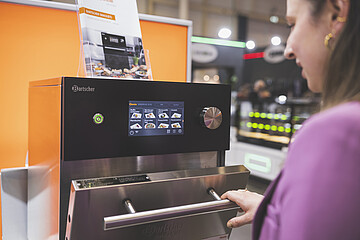
Foodservice in the German retail sector grew by 7.1 per cent to EUR 13.29 billion in 2025.6 Supermarkets and petrol stations require compact appliances with short cooking times, as presented by companies including Bartscher, Panasonic, Unox and Welbilt (Merrychef). Demand is also growing in schools. Since 1 August 2026, children in the first year of primary school in Germany have had a legal entitlement to all-day care. This entitlement will be extended gradually to all primary school year groups by 2029. School canteens need food distribution systems that can deliver large volumes to the serving point quickly and at the correct temperature, such as solutions from B.PRO, HUPFER and Scholl. For professionals in communal catering, 15 March is also worth noting, as this is when the Branchentag der Gemeinschaftsgastronomie takes place.
INTERNORGA Future Award and programme: Innovation meets craftsmanship
The INTERNORGA Future Award demonstrates each year where kitchen technology is heading in its Technology & Equipment category. In 2025, Hobart won with Smart Vision Control, a dishwasher that uses AI to control its own washing parameters. In 2026, the award went to goodBytz for an autonomous cooking system. Exhibiting companies can apply free of charge for the INTERNORGA Future Award 2027 until 10 January 2027.
Hall B6 will also host the NO BULLSHIT AREA by freakstotable. Its open, direct and practical programme addresses the future of gastronomy and food while also sharing and preserving culinary knowledge. The NEXT CHEF AWARD will also take place in Hall B6. INTERNORGA launched the competition together with Johann Lafer in 2016. Young culinary talents aged up to 30 will compete on 14 and 15 March. In the final, the six best participants will recreate a dish by Johann Lafer without a recipe. In Hall B7, the Pizza Experience will focus on the art of pizza making, with professionals presenting trends, techniques and ingredients in workshops and shows. The highlight will be the German Pizza Bakers’ Championship on 15 March 2027.