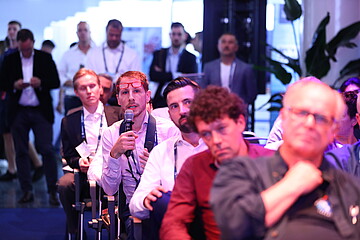
Across five open stages, SMM 2026 will bring international conferences, panels and debates directly into the exhibition halls. All formats are free of charge for holders of an SMM exhibition ticket, with the exception of the TradeWinds Shipowners Forum.
Whether at the Energy Efficiency Stage (Hall A4), Open Stage (Hall B2.OG), Exhibitor Innovation Stage (Hall B5), Digital Stage (Hall B6) or Naval Stage (Hall B8), visitors can expect continuously changing formats dedicated to the key topics shaping the industry. Conference formats include the Global Maritime Environmental Congress (gmec), the TradeWinds Shipowners Forum, the Maritime Future Summit, the Offshore Dialogue and MS&D – International Conference & Expo for Maritime Security & Defence. The Exhibitor Innovation Stage offers compact presentation slots for exhibitors showcasing their latest products and technologies. International stakeholders from across the maritime industry will come together on SMM’s stages to exchange ideas and perspectives.
“The open stages create space for direct dialogue between industry, politics, navies and academia. This is exactly the kind of dialogue the maritime industry needs to shape the future of the sector together,” says Claus Ulrich Selbach, Vice President Exhibitions Maritime & Energy at Hamburg Messe und Congress.
Decarbonisation and Energy Efficiency in Focus
The IMO’s goal of achieving climate-neutral shipping by 2050 can only be reached through close cooperation across the industry and the combination of energy-efficient technologies. Numerous sessions will therefore explore which energy sources could power shipping in the future – and whether sufficient quantities will be available. The industry is certainly not short of technical solutions: “With climate-neutral fuels and comparatively little adaptation effort, existing engines could in future be operated almost CO2-neutrally,” says Hauke Schlegel, Managing Director of VDMA Marine Equipment & Systems. VDMA is cooperation partner of the session. Another important lever for reducing maritime emissions is shore power infrastructure. Together with industry association EOPSA, a further session will present concrete approaches for expanding energy supply during port stays.
The Global Maritime Environmental Congress (gmec) will also address the pressing questions surrounding the path towards climate neutrality. Discussions will cover political frameworks as well as lighthouse projects such as green shipping corridors, which serve as test routes for new propulsion systems, alternative fuels, shore power and optimised port processes. The offshore industry also plays a key role in global decarbonisation as an important source of green electricity from wind energy. The Offshore Dialogue will address, among other topics, how the security and resilience of offshore energy supply can be strengthened in the long term.
New Business Models and International Markets
The Open Stage will focus on new business models, intelligent technologies and the economic future of the maritime industry. The internationally renowned TradeWinds Shipowners Forum will once again be part of the SMM programme. Discussions will cover developments in ship financing, fleet strategies and the changing dynamics of global shipping markets.
Design, Passenger Experience and Maritime Industrial Policy
One session focusing on the future of the passenger experience at sea will examine how design decisions influence perception, behaviour and the attractiveness of travelling by sea – and whether increasing functional optimisation risks gradually “engineering out” the onboard experience. Another session will address current industrial policy developments in Europe, focusing on the EU Industrial Maritime Strategy. Cooperation partner is SEA Europe, the leading European association representing shipyards and maritime equipment manufacturers.
Smart Shipping and Maritime Innovation
The decarbonisation of cruise fleets through retrofitting measures will also play an important role under the leadership of CLIA Europe, the world’s largest cruise industry association. At the Digital Stage, the spotlight will be on data-driven systems, automation and intelligent technologies for shipping – ranging from remote monitoring to autonomous surface and underwater systems produced using 3D printing technologies. With the Maritime Future Summit, SMM presents a platform for new technologies and digital innovation. A key topic will be how generative AI could transform ship design, operations and efficiency in the future. Leading companies, maritime stakeholders and start-ups will provide insights into the next generation of maritime technologies – from AI and GenAI applications to autonomous systems.
Skilled Labour, Career Paths and Future Maritime Jobs
With the Maritime Career Market & Forum (MCM), SMM is also placing a spotlight on talent recruitment within the maritime industry. At the Career Forum, companies, universities and young professionals will discuss how maritime professions are evolving through digitalisation, decarbonisation and international transformation. The programme will be complemented by networking and matching formats connecting young talents and companies.
Maritime Security and Defence Move into Focus
The wars in Ukraine and the Gulf region, as well as tensions along international trade routes, are bringing security issues increasingly into focus worldwide. The Naval Stage will address these developments and the broader issues surrounding maritime security and defence. Experts will discuss, among other topics, how Europe can strengthen its defence capabilities through closer cooperation within the European naval industry and what role EU funding programmes can play in this context. Central themes include the expansion of European naval forces and maritime security structures. Many EU countries have significantly increased their defence budgets in recent years.
On Thursday and Friday, the Naval Stage will be fully dedicated to the MS&D – International Conference & Expo for Maritime Security & Defence, organised by the German Maritime Institute. The conference traditionally brings together high-ranking representatives from EU institutions, defence ministries, navies, procurement authorities as well as the civilian and military maritime industry. Among the speakers is Vice Admiral Carsten Stawitzki. The Director General for Armaments at the German Federal Ministry of Defence emphasises: “The protection of NATO territory can only be achieved through international cooperation in procurement.”
With its high-profile stage and conference programme, SMM 2026 underlines its position as a global platform for knowledge transfer, political dialogue and international exchange within the maritime industry.