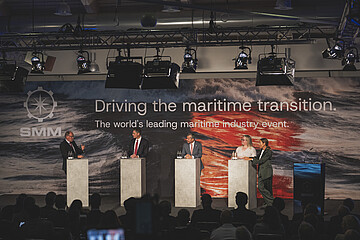
Security and resilience are becoming increasingly important for the maritime industry. At the same time, decarbonisation, digitalisation and competitiveness remain key challenges. At the opening of SMM 2026, high-ranking representatives from politics, business and international organisations discussed how the industry is repositioning itself in response to changing geopolitical and economic conditions.
Highlighting SMM’s role as an international meeting place for the industry, Heiko M. Stutzinger, CEO of Hamburg Messe und Congress, welcomed the guests together with fellow CEO Uwe Fischer: “Internationality, innovation and an unparalleled wealth of information: SMM is and remains the driving force shaping the maritime future.”
Hamburg’s Senator for Economic Affairs, Dr Melanie Leonhard, also emphasised the city’s maritime expertise and international appeal in her welcome address. As a European gateway for trade, energy and data, Hamburg has a particular responsibility for secure and resilient maritime infrastructure.
SMM brings the international maritime community together in Hamburg: Around 2,300 exhibitors from up to 70 countries and 50,000 participants from 120 nations are expected. Across more than 90,000 m² of exhibition space in twelve exhibition halls, the trade fair showcases the entire maritime industry value chain. The entire exhibition grounds are fully booked.
Security and resilience gain importance
The protection of critical maritime infrastructure and growing strategic dependencies were at the heart of the security debate. Christian Hirte, Parliamentary State Secretary at the Federal Ministry of Transport, and Emma Salisbury, Senior Fellow at the Foreign Policy Research Institute and Associate Fellow at the Royal Navy Strategic Studies Centre, focused in particular on the need for international cooperation and joint responses to emerging maritime threats.
Knut Ørbeck-Nilssen, Group President and CEO at DNV, broadened the perspective to the range of simultaneous uncertainties the industry must navigate: “Shipping is navigating a period of significant uncertainty, with technology, regulation, energy, and not least geopolitics all evolving at the same time. The companies that succeed will be those that remain adaptable to face these uncertainties.” Looking further ahead, Ørbeck-Nilssen also pointed to nuclear energy as a potential part of the maritime energy transition, highlighting Small Modular Reactors (SMRs) and the growing involvement of technology companies in their development.
With the new Naval Hall B8, maritime security and defence have their own dedicated hall for the first time. The Naval Stage, the MS&D Conference & Expo, exhibiting companies and international naval delegations make the topic a major focus throughout the four days of the trade fair.
Competition and cooperation
Global changes are also creating new opportunities for growth. India is one example. Shri Vijay Kumar, Secretary at India’s Ministry of Ports, Shipping and Waterways, outlined the country’s long-term growth strategy in his keynote address. The Maritime Amrit Kaal Vision 2047 envisages extensive investment in the maritime sector. India is also looking to attract international investment, foster technology partnerships and strengthen industrial links with Europe. India’s growing importance is also reflected at SMM: in 2026, the country is represented with its own national pavilion for the first time.
Strong competition from Asia has long been a reality for Europe’s shipbuilding industry – while global dynamics are also opening up new opportunities.
Anu Ahola, Chief Strategy and Transformation Officer at shipbuilding company Meyer Turku, said: “Europe can remain competitive, if we choose our battles and are ready to protect. The unpleasant new world order forces the European maritime ecosystem to renew itself.”
For Dr Gaby Bornheim, President of the German Shipowners’ Association (VDR), maritime strength and Europe’s security are directly linked: “Europe’s resilience depends on a strong and internationally competitive shipping sector. European shipowners connect our industry to global markets, secure supply chains and provide essential maritime capacity in times of crisis. We therefore need a regulatory framework that enables investment and decarbonization without driving companies, vessels and expertise out of Europe. Keeping shipping competitive in Europe is a strategic necessity for Europe.”
Global rules for a global industry
There is broad agreement that a global industry needs global rules. John Denholm, Chairman of the International Chamber of Shipping (ICS), summed it up: “Shipping is a global industry, the rules and regulations that govern our industry must also be global. We cannot build a resilient maritime industry on a patchwork of national and regional regulation.”
Dr Uwe Lauber, CEO of leading engine manufacturer Everllence, made clear that technology is now ahead of regulation: “Maritime security, resilience and AI may dominate today’s agenda, but shipping’s decarbonization remains our obligation. The technology is ready. What we need now is a credible IMO Net-Zero Framework that creates certainty for investment and rewards decarbonization. Every delay favors fossil fuels over climate-neutral alternatives. The gap is no longer technological, it is political.”
This brought the focus to the International Maritime Organization (IMO), which sets the global framework for the transformation of shipping. The IMO is working intensively on a concrete pathway towards achieving the net-zero target by 2050. Until there is clarity about the future regulatory framework, however, shipping companies must remain cautious in their investment decisions.
At the same time, IMO Secretary-General Arsenio Dominguez made clear that the maritime transformation is not only a challenge but also an industrial opportunity. Alternative fuels, digitalisation, AI and automation are becoming important drivers of growth and competitiveness. Alongside decarbonisation, he highlighted another central issue in his keynote address: the safety of people at sea: “Secure sea lanes are essential for global trade, but first and foremost this is about protecting people. Seafarers must be able to do their jobs without risking their lives.”
The IMO Secretary-General then officially opened SMM 2026.
“The discussions at the opening show that decarbonisation, digitalisation, security and resilience can no longer be viewed as separate challenges but must be addressed together. SMM brings together the decision-makers who are shaping this transformation and determining the future of the maritime industry,” said Claus Ulrich Selbach, Vice President Exhibitions Maritime & Energy at Hamburg Messe und Congress.
Over the next four days, these issues will be discussed, negotiated and addressed across the Hamburg exhibition grounds. In addition to around 2,300 exhibitors, five stages and five specialist conferences provide platforms for dialogue and knowledge transfer. Running parallel to SMM, ALL ABOUT PORTS and LogiNext Germany at the CCH – Congress Center Hamburg extend the programme to include the port industry and digital logistics.